
The Stations of the Cross
Our Stations of the Cross are hung in the main body of our church on the north west wall. The stations look like wood, but are a special composite material, and were made in Italy by the same company that made our Mary and Joseph statues. These Stations of the Cross are a beautiful addition to our church and our hope is that you take advantage of them and pray the stations anytime during the day. The stations of the Cross that are hung in the chapel were painted by Jeremy Caniglia the son of parishioners Jeff and Donna Caniglia.
Pray the stations online, click here to begin. The prayers at each station were written by Fr. Fitzgerald
Thank you so much to the donors of these stations and in whose memory they were given:
- Florence Walsh in memory of Donna Walsh
- Maria Sanchez in memory of Pat Sanchez
- Bob Schmid in memory of Doris Schmid
- Ken Liebschwager in memory of Dorothy Liebschwager
- Theresia Horrum in memory of Dick Horrum
- Mark Koscis in memory of Sue Kocsis
- Mary Clare Mendick in memory of Dan Mendick
- Gail and Ruthie Trede in memory of Mr. & Mrs. Patrick Daly, Sr., Richard R. Daly and Michael J. Daly
Sculptures
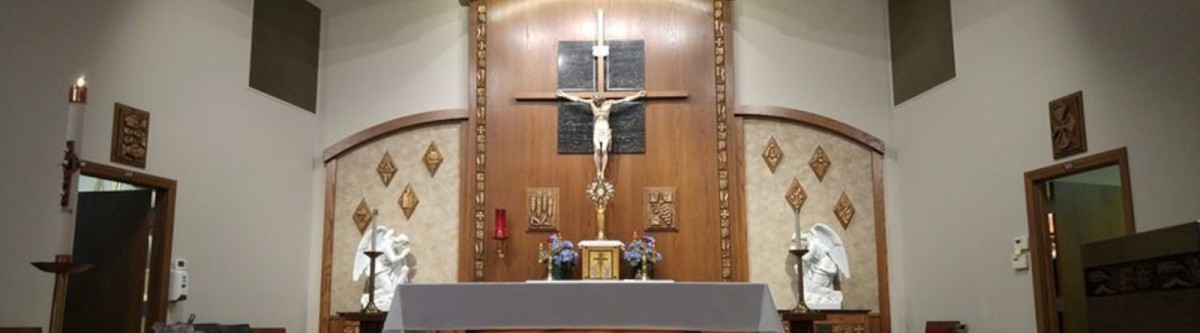
For many years, the resurrected Christ was erected on the wall behind the main altar in the church, while the crucified Christ remained in storage, except for the season of Lent. After consulting with our parish council, several parishioners, and with the permission of Lou and Kathy D'Ercole, the donors of the resurrected Christ, it was decided to permanently erect both breath-taking sculptures in our church so that we all can enjoy their beauty year-round.
Many of us are old enough to remember that the "Mass" was commonly known as the "Holy Sacrifice of the Mass". At every Mass, the sacrifice of Christ on Calvary is renewed. It is one and the same sacrifice He made for us over two thousand years ago, and is now made present to us (sacramentally) on our altars. The only difference now is that His perpetual offering of Himself, in giving us His Body and Blood, is an unbloody sacrifice, but it is still the same sacrifice. We, on our part, and as His disciples, are there to unite our own sacrificial offering of ourselves with His sacrificial offering for the salvation of souls, including our own. That is why the Catholic Church has traditionally erected crucifixes in our sanctuaries near our altars. The crucifix is a beautiful reminder to all of us of the great mystery we are not only witnessing on our altars, but partaking of as well. And that is why, traditionally, the Church has always required that the crucified Christ be erected in our sanctuaries near the altar, even outside the celebration of the Mass (General Instruction of the Roman Missal, # 308). And, so, it was decided to permanently erect our crucified Lord behind the altar. Jesus' sacrificial offering of Himself is not merely a Lenten reality, but is a reality for all times and for all places. It is a reality we celebrate, not just during the season of Lent, but throughout the entire year every time we come to the Holy Sacrifice of the Mass.
The most appropriate place for the resurrected Christ, on the other hand, seemed to be in the narthex of the church. This joyful image of the resurrected Christ would still be very visible to us in our church, and it is a beautiful reminder of the mandate Jesus gave each us as He ascended to His Father and ours. And that mandate is to "go, therefore, and make disciples of all nations. And that He would be with [us] always, until the end of the age" (Mt. 28:19-20).
Having both sculptures on permanent display also reminds us that we cannot have one without the other. As a disciple of Christ, we can only share in the glorious victory and joy of the Resurrection to the degree we are willing to share in His suffering and death. In other words, no cross, no glory! May the good Lord grant each of us a renewed love for the cross, and a greater courage to take it up with Him for the salvation of our souls and the souls of countless others! May our union with the passion and death of our Lord Jesus Christ lead each of us to the glory and unlimited joy of His resurrection! And may our risen Lord, crucified for our sins, bless each of us and your families in abundance!
Patron Saint
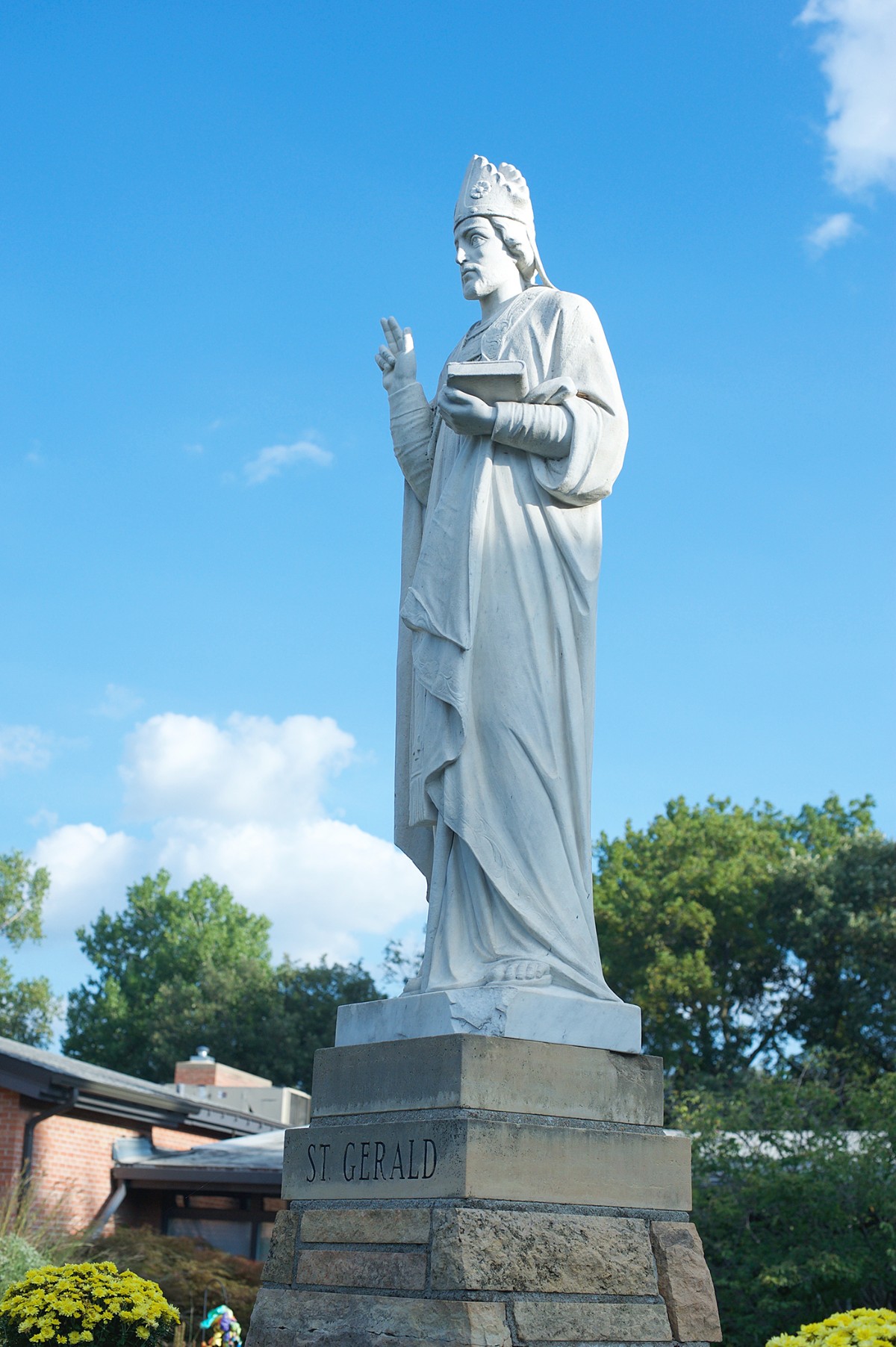 St. Gerald of Mayo, a Benedictine monk and abbot, was chosen as the titular saint. He died in 732 A.D. He was an Englishman with very little known about his life. As the story goes, he accompanied St. Colman to Ireland after the Celtic way of observing Easter was forbidden in Northumbria, England. This group of of monks ultimately split into an Irish and English monastery. St. Colman stayed with the Irish group and St. Gerald became the abbot of the English group at Mayo. March 13th is his feast day.
Our parish shrine with the statue of St. Gerald was blessed May 24, 1962, by Archbishop Gerald T. Bergan, followed by Mass. The Rev. J. Hanna, S.J., 80, laid the Kasota stone. The only one of its kind in the country, the St Gerald statue is made of white Carara marble and was designed in Italy
In May, 1957 as Father William Foster stood surveying four acres of land which had been the Ralston Golf Course at 78th and Lakeview, the words of Archbishop Gerald T. Bergan echoed in his head, "I want you to go out to Ralston and build a church and a school."